
Heat rises. Without insulation at the top of the house, it keeps going.
The fastest payback of any home energy upgrade, done properly.
A quarter or more of the heat in an uninsulated house leaves through the roof. Nothing else you can do to a home returns as much comfort and saving for as little money.
The standard approach for a cold-roof attic is insulation laid between and over the ceiling joists, bringing the total depth up to current standards. Depth is what matters — a thin original layer does a fraction of the work of a full build-up. Laying the second layer perpendicular to the first covers the joists themselves, which would otherwise act as a grid of thermal bridges across the whole ceiling.
We also deal with the details most installers skip:
For converted attics, vaulted ceilings and flat roofs.
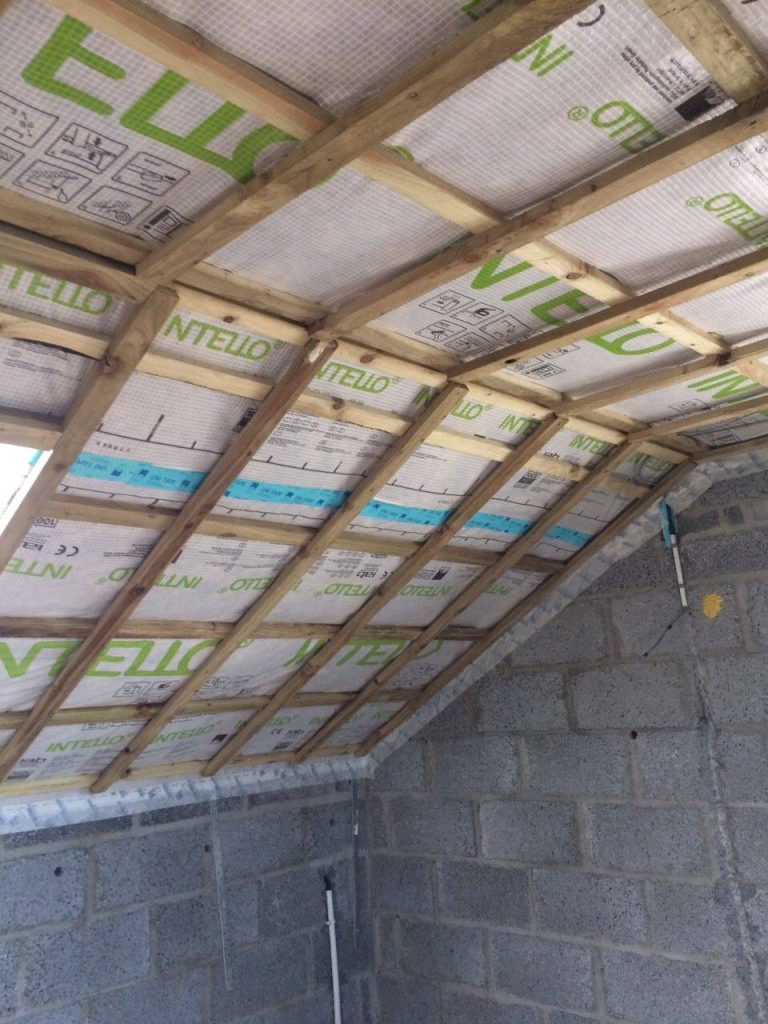
Where the attic is a habitable room, a converted space, or a vaulted ceiling, insulation goes at rafter level instead, bringing the roof space inside the heated envelope.
Rafter insulation needs a ventilation gap above the insulation and careful attention to vapour control below it. Get either wrong and you trap moisture in the roof structure. We specify the build-up after inspecting the roof construction, not from a catalogue.
Flat roofs are usually upgraded as warm roofs — insulation above the deck, under a new waterproof covering. It’s typically done when the roof covering is due for replacement anyway, which makes the insulation cost marginal.
From insulation to heat pumps, ventilation and more. Improve comfort, lower bills and increase your BER rating.
New builds, extensions and deep retrofits, fully managed from design and planning through to construction and completion.
High-quality solar panel systems for homes, farms and businesses. Lower energy costs and gain energy independence.
Energy upgrades and construction solutions for commercial, agricultural and public sector projects.
Insulating a roof makes the space above the insulation colder. If moist air from the house can get up there and there’s nowhere for it to go, you get condensation on the underside of the roof and, eventually, rot in the timbers.
The fix is straightforward but it has to be deliberate: seal the ceiling plane against air leakage, and keep the ventilation path at the eaves clear. Every attic we insulate is assessed for both.
Attic insulation is supported under SEAI grant schemes, and it’s one of the measures included in the fully funded Warmer Homes Scheme for eligible households. We handle eligibility checks and applications as part of the service.
Current standards call for a substantially deeper layer than was typical in older homes. We’ll confirm the target depth for your build-up at survey.
Almost always, yes. Going from a thin original layer to full depth is inexpensive and makes a clear difference.
Yes, with raised boarding. Boarding laid directly onto the joists compresses the insulation and defeats the purpose, so we install a raised platform over the area you want to use.
A standard attic is usually a one-day job. Rafter insulation and flat roofs take longer.
Yes — that’s the point. The heat stays in the house instead. Which is why tanks and pipes need insulating and ventilation needs checking.
Call 051 850722 for a free quotation. Most attics are a one-day job and the difference is immediate.