
The right heating system for the right house — in that order.
A heat pump is most efficient when it delivers heat at a low temperature over a long period. That only works if the house holds onto it.
A heat pump doesn’t burn fuel to make heat. It moves heat that already exists in the outside air into your home, and it does it efficiently enough that every unit of electricity it uses delivers several units of heat.
That’s the theory, and in a well-prepared house it holds. In a poorly prepared one it doesn’t — which is why heat pumps have a mixed reputation among people who had one fitted into a house that wasn’t ready for it. For a heat pump to do what it’s supposed to, the building has to hold onto the heat:
Skip these and the heat pump compensates by working harder, using its backup immersion heater, and running your electricity bill up. Which is why our heat pump projects start with a home energy assessment, not a product selection.
Three things separate a heat pump installation that is cheap to run from one that is not.
Heat loss calculation. A room-by-room calculation of what the house actually needs, not a rule of thumb from floor area. Oversizing is the most common error — an oversized unit cycles on and off, wearing itself out and running inefficiently.
System design. Flow temperature, emitter sizing, pipework, buffer arrangement and cylinder all designed as one system rather than assembled from parts.
Commissioning. The settings a heat pump leaves the factory with are not the settings your house needs. Weather compensation curves, flow temperatures and hot water schedules are set on site and adjusted. A unit that’s installed but never properly commissioned will underperform for its entire life.
From insulation to heat pumps, ventilation and more. Improve comfort, lower bills and increase your BER rating.
New builds, extensions and deep retrofits, fully managed from design and planning through to construction and completion.
High-quality solar panel systems for homes, farms and businesses. Lower energy costs and gain energy independence.
Energy upgrades and construction solutions for commercial, agricultural and public sector projects.
Heat pumps work differently to boilers, and the habits are different too. They suit steady background heat rather than short bursts, and they’re at their best left to run at a low temperature rather than switched on and off through the day.
Most people adapt within a week and prefer it — the house sits at an even temperature all day instead of swinging between cold mornings and overheated evenings. We take the time to walk you through the controls at handover rather than leaving a manual on the counter.
Heat pump installation is grant supported through SEAI. The grant requires the home to meet a minimum heat loss indicator, which is another reason the fabric work comes first — a house that fails the threshold won’t qualify until it’s upgraded. We check that threshold as part of the assessment and handle the grant application from start to finish.
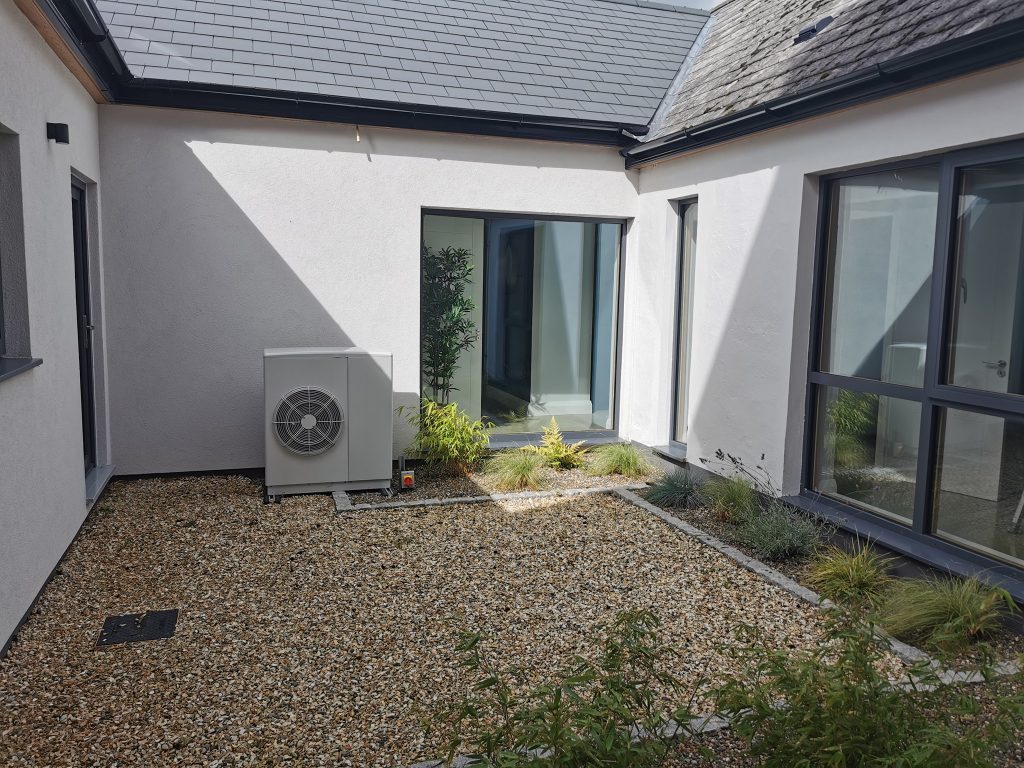
It will, once the house has been upgraded to hold heat. In an unimproved old house it will work badly and cost a lot to run. The sequence matters more than the age of the building.
Often yes, at least in some rooms. Radiators sized for a boiler’s high flow temperature are undersized for a heat pump. The heat loss calculation tells us which rooms need changes.
Yes. They’re less efficient at low outdoor temperatures, but Irish winters sit comfortably within their operating range.
Modern units are quiet, but they’re not silent and they sit outside. Position is chosen at design stage with neighbours and bedroom windows in mind.
Hybrid arrangements are possible but they’re not usually the best answer, and they can affect grant eligibility. We’ll advise based on your house.
We’ll assess the building first and tell you straight whether a heat pump is the right next step, or whether your money does more elsewhere.