
The answer when the outside of the house has to stay as it is.
Insulation fixed to the inside face of the external walls, room by room.
Not every home can be insulated externally. Protected structures, houses built right up to a boundary, properties where the brickwork or stone is the whole character of the building — for all of these, the insulation has to go on the inside.
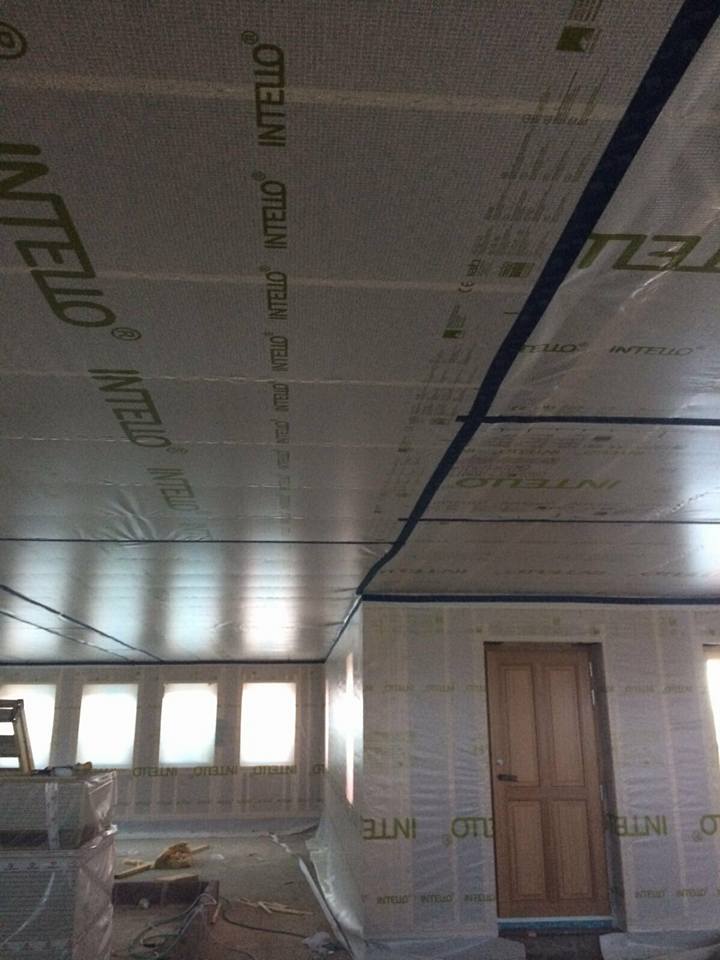
Insulated plasterboard, or an insulation layer with a separate board finish, is fixed to the inside face of the external walls. Joints are sealed, a vapour control layer is maintained, and the wall is skimmed and decorated as normal. Work is carried out room by room, so the house stays liveable throughout. Skirtings, architraves, sockets, switches and radiators are removed and reinstated as part of the job.
It delivers the same thermal improvement as its external counterpart. It asks more of the detailing and costs you a little floor area, but on the right house it’s the right call.
Where external insulation is not possible, permitted or appropriate.
It’s also common to mix approaches — external insulation to the rear and gables, internal to a protected front elevation.
A typical internal build-up takes 60–100mm off each external wall. In a large room that’s barely noticeable. In a small bathroom or a narrow hall it needs thinking about, and we’ll show you the numbers room by room before you commit.
From insulation to heat pumps, ventilation and more. Improve comfort, lower bills and increase your BER rating.
New builds, extensions and deep retrofits, fully managed from design and planning through to construction and completion.
High-quality solar panel systems for homes, farms and businesses. Lower energy costs and gain energy independence.
Energy upgrades and construction solutions for commercial, agricultural and public sector projects.
Internal wall insulation is unforgiving of shortcuts. Three things decide whether a job performs.
Continuity at junctions. Where an internal wall or a floor meets the external wall, heat can bypass the insulation. These junctions need to be insulated back into the room — returns at reveals, at floor and ceiling lines, and around party walls.
Vapour control. The insulation makes the masonry behind it colder. Without a properly sealed vapour control layer, moist internal air reaches that cold surface and condenses inside the build-up. That’s how interstitial condensation problems start, and they’re expensive to fix.
Ventilation. Tightening the internal envelope changes how the house breathes. Ventilation has to be assessed alongside the insulation, not after it.
Internal wall insulation is supported under SEAI grant schemes, both individually and as part of a One Stop Shop deep retrofit. We handle eligibility, application and compliance documentation as part of the service.
On thermal performance the insulation itself performs the same. External has the edge on continuity because it wraps the junctions automatically. Internal can match it, but only with careful detailing — which is exactly what we specify for.
No. We work room by room. You’ll need to clear the rooms being worked on, but the house stays occupied.
Removed and reinstated. Radiators are typically brought forward onto the new wall line; electrical points are extended and refitted.
Skirtings and architraves come off and are refitted or replaced. Window boards usually need replacing because the reveal depth changes.
Call 051 850722. We’ll assess the walls, the junctions and the ventilation together, and show you the build-up room by room.