
Structure and insulation built in a single operation.
Insulated formwork stays in place permanently, wrapping a reinforced concrete core.
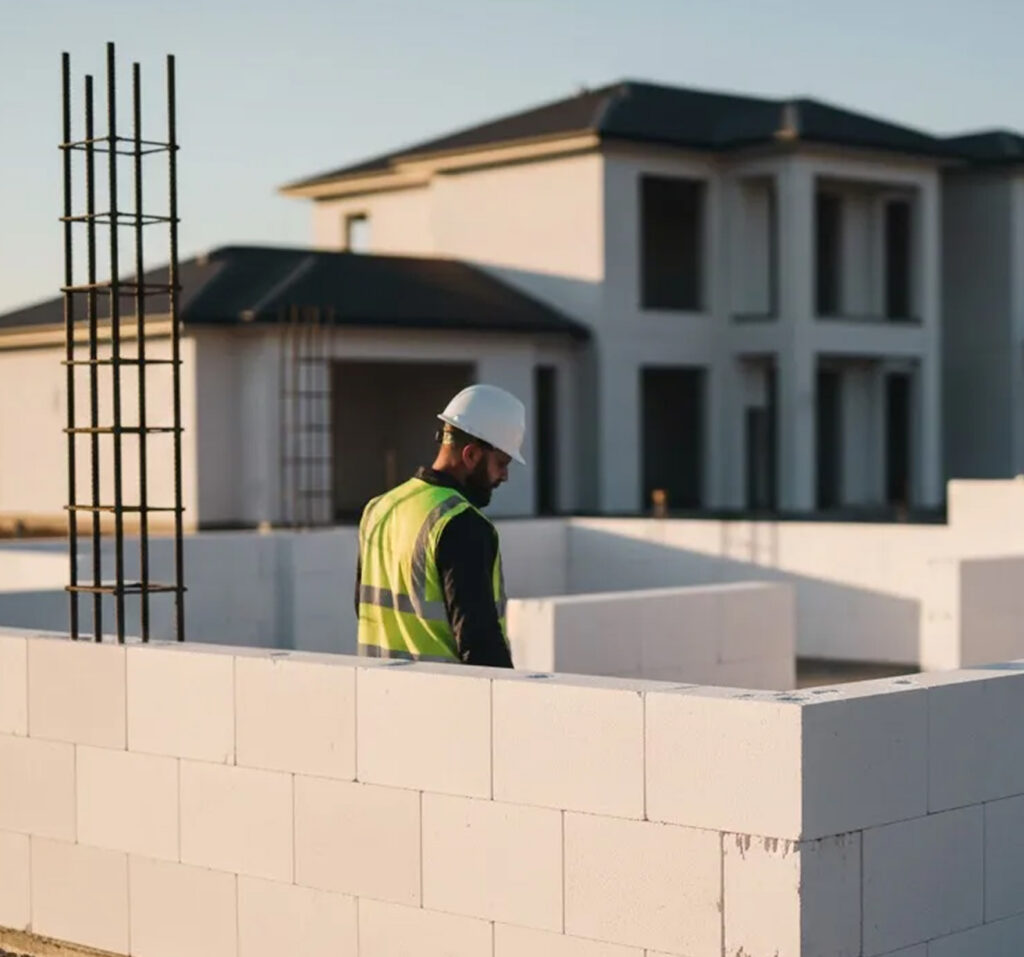
Insulated Concrete Formwork builds the wall and its insulation in a single operation. Hollow insulated blocks are dry-stacked to form the shape of the building, reinforcement is placed inside them, and concrete is poured into the cavity. The formwork stays in place permanently as the insulation layer, inside and out.
What you end up with is a reinforced concrete structure wrapped in continuous insulation on both faces, with no cold bridges running through it and very few joints for air to pass through. Airtightness results on ICF builds are routinely excellent without the elaborate taping and membrane work a timber frame demands.
It’s a system that suits Irish conditions well: robust, weather-tolerant during construction, and thermally very capable.
Thermal mass, airtightness, acoustic performance and structural strength.
The characteristics that tend to matter to clients:
It also reaches Passive House and NZEB targets comfortably, which makes it a sensible starting point where high performance is the brief.
From insulation to heat pumps, ventilation and more. Improve comfort, lower bills and increase your BER rating.
New builds, extensions and deep retrofits, fully managed from design and planning through to construction and completion.
High-quality solar panel systems for homes, farms and businesses. Lower energy costs and gain energy independence.
Energy upgrades and construction solutions for commercial, agricultural and public sector projects.
ICF rewards planning and punishes improvisation. Service routes, openings, fixings and the pour sequence all need to be settled before the concrete goes in, because afterwards you are chasing into reinforced concrete rather than cutting a stud.
The pour itself is the moment that matters. Bracing, pour rate and vibration all have to be right, and a blowout is expensive and messy. This is where experienced crews earn their money, and it’s the main reason ICF should not be a contractor’s first attempt at the system.
Exposed and coastal sites, one-off homes targeting high performance, buildings where acoustic comfort matters, and clients who want structure and insulation resolved in a single operation rather than coordinated across trades.
We take ICF projects from design through to completion. Because the system decisions interlock with the ventilation, heating and services design, having one party carry all of it avoids the coordination gaps that cost money on site.
Structure alone can cost more. Compared like for like — against a block build brought to the same insulation and airtightness performance — the gap narrows considerably or disappears.
Yes. It’s an established system with certification and a long track record.
Through the formwork into the concrete core, with appropriate fixings. Heavy items are straightforward; it’s just a different technique.
Foundations are designed for the loads, as with any system. An insulated raft is a common and effective pairing.
Very. Continuous insulation and inherent airtightness make the targets considerably easier to hit.
Call 051 850722. The system decisions interlock with services and heating, so it pays to plan them together.