
Fresh air in every room, without throwing the heat out with the stale air.
Two air streams, one heat exchanger, and they never mix.
Every ventilation system has the same problem: the air you extract is warm, and you paid to heat it. In a leaky house that barely registers because heat is escaping everywhere anyway. In an airtight, well-insulated home it becomes the dominant heat loss.
Mechanical ventilation with heat recovery solves it. Stale, moist air is extracted from kitchens, bathrooms and utility rooms and passed through a heat exchanger on its way out. Fresh air drawn in from outside passes through the same exchanger in a separate stream, picking up most of that heat before it’s delivered to bedrooms and living rooms.
The two air streams never mix. You get continuous fresh air and you keep the heat.
The ventilation system for airtight buildings — and only for airtight buildings.
MVHR is the ventilation system for airtight buildings. It’s standard in new builds to NZEB standard and in deep retrofits where airtightness has been properly addressed. It is the right choice when:
It’s the wrong choice in a leaky building. MVHR relies on controlling where air enters and leaves; in a house full of uncontrolled leakage paths the heat recovery benefit largely evaporates. If your building isn’t airtight and isn’t going to be, demand control ventilation is the more sensible system.
From insulation to heat pumps, ventilation and more. Improve comfort, lower bills and increase your BER rating.
New builds, extensions and deep retrofits, fully managed from design and planning through to construction and completion.
High-quality solar panel systems for homes, farms and businesses. Lower energy costs and gain energy independence.
Energy upgrades and construction solutions for commercial, agricultural and public sector projects.
MVHR performance depends almost entirely on design and installation quality. The unit itself is the easy part.
Duct design. Duct runs should be short, smooth and generously sized. Long, tight, over-restricted ductwork forces the unit to work harder, generates noise and delivers less air than designed.
Commissioning and balancing. Every supply and extract terminal is measured and adjusted so the system delivers designed flow rates and the building stays balanced. An uncommissioned MVHR system is a very expensive extract fan.
Unit location. The unit needs to be accessible for filter changes, and positioned so noise and condensate drainage are handled properly. Ductwork above the insulation line in an attic must be insulated, or you lose the heat you just recovered.
Day to day there’s nothing to do. The system runs continuously at a low rate, boosting automatically when humidity rises. The one maintenance task is filter changes, typically once or twice a year. We set out a schedule at handover and can service the system for you.
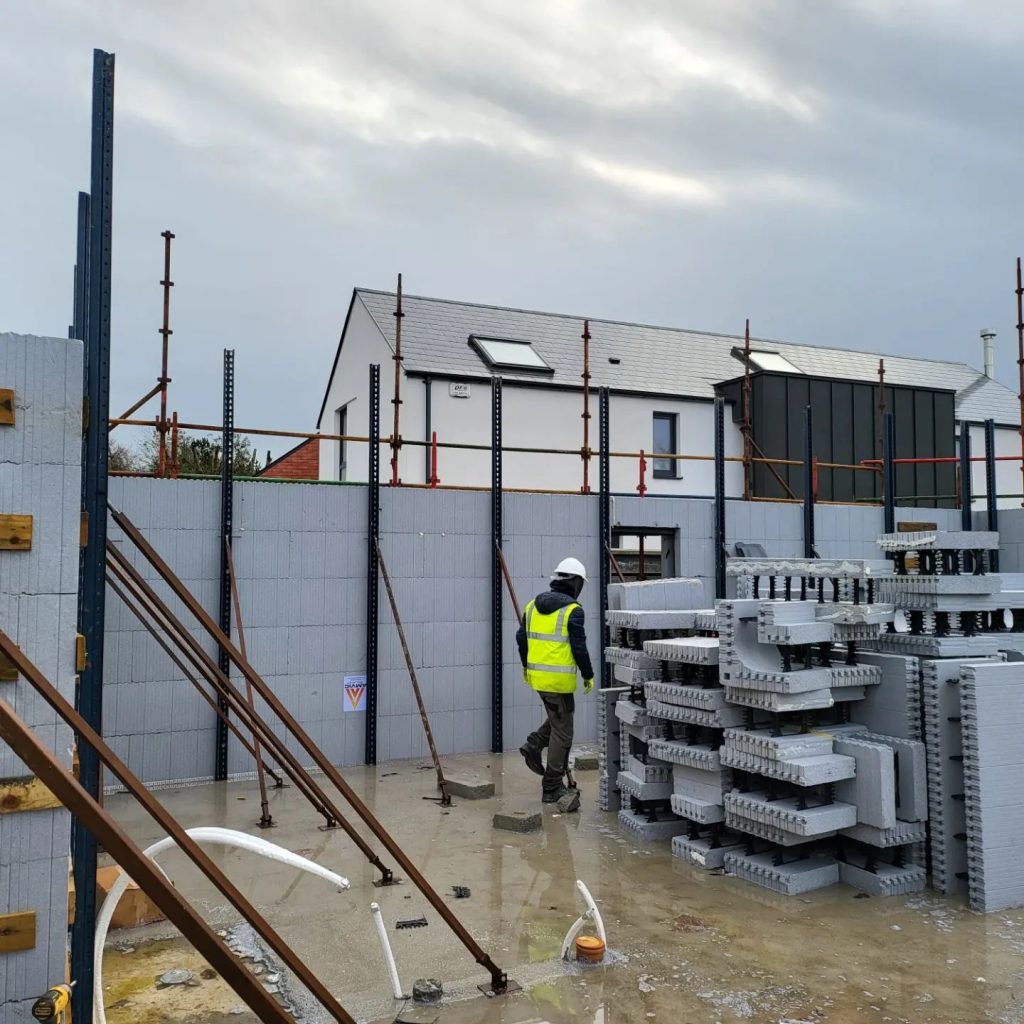
A well-designed system is barely audible. Noise complaints almost always trace back to undersized ducts, sharp bends or a poorly located unit — design problems, not product problems.
It’s possible, but the ductwork is the constraint. It’s far more practical during a deep retrofit or extension when floors and ceilings are open. In an occupied house with finished surfaces, DCV is usually the more realistic option.
It provides your background ventilation continuously, which windows don’t. You can still open them whenever you like.
The fans use a small, continuous amount of electricity. In an airtight house the heat recovered substantially outweighs that.
Airtight building: MVHR. Existing building that isn’t being made airtight: DCV. We’ll confirm after survey.
Call 051 850722 to discuss ventilation design. Get it specified early, while the ductwork is still easy to route.