Turn your roof into a generator, and stop buying what you could make.
Irish daylight is perfectly adequate for this.
A domestic solar PV system turns your roof into a generator. Panels convert daylight into electricity, an inverter makes it usable in the house, and everything you generate and use is electricity you don’t buy.
Irish daylight is perfectly adequate for this. Solar panels work on diffuse light as well as direct sun, and while output is obviously higher in June than December, a correctly sized system delivers a meaningful share of a household’s annual electricity.
The economics have shifted in solar’s favour over the last few years: panel costs have fallen, electricity prices have not, grant support is available, and exported electricity is now paid for under the Clean Export Guarantee rather than given away.
Self-consumption is where the value is.
Self-consumption is where the value is. A unit you use as you generate saves you the full retail price including standing charges; a unit you export earns a lower rate. So the goal is to use as much of your own generation as possible.
From insulation to heat pumps, ventilation and more. Improve comfort, lower bills and increase your BER rating.
New builds, extensions and deep retrofits, fully managed from design and planning through to construction and completion.
High-quality solar panel systems for homes, farms and businesses. Lower energy costs and gain energy independence.
Energy upgrades and construction solutions for commercial, agricultural and public sector projects.
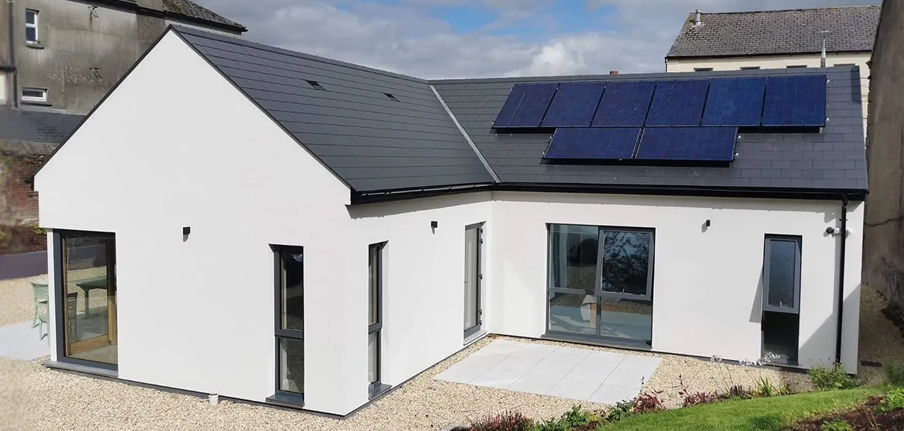
Roof orientation matters less than people assume. South-facing gives the highest peak output, but east-west arrays produce a flatter curve across the day, which often means more of the generation gets used in the house rather than exported. Either can be the right answer.
Shading matters more. A single chimney, tree or neighbouring gable shading part of an array can cut output disproportionately, depending on how the panels are wired. We assess shading properly at survey and design the array and its electronics around what we find.
Domestic solar PV is grant supported through SEAI, with the grant level tiered by system size and revised periodically. The home must meet the scheme’s build-date condition. We confirm eligibility, handle the application and take care of the ESB Networks notification.
Most domestic installations are completed in a day or two. Scaffolding goes up, panels are mounted and wired, the inverter is installed and the system is commissioned and handed over with monitoring set up so you can see what it’s doing.
Yes. Panels generate from daylight, not just direct sunshine. Output is seasonal, but annual generation from a well-designed system is substantial.
Not necessarily. A battery increases self-consumption but adds cost. For many households a hot water diverter delivers better value first.
It’s exported and paid for under the Clean Export Guarantee, at a rate lower than you pay to import.
Not when mounted correctly. The mounting system is designed to maintain weatherproofing, and we check the roof structure before installing.
Panels carry long performance warranties and degrade slowly. Inverters have a shorter service life and are usually the first component to be replaced.
Call 051 850722 for a free solar assessment. We’ll check orientation, shading and your usage before quoting anything.